The Vienna Insurance Group’s core competence is dealing professionally with risk. The insurance business consists of deliberately assuming diverse risks and managing them profitably. One of the primary responsibilities of the Vienna Insurance Group’s risk management is to ensure that the obligations assumed under insurance policies can be satisfied at all times.

The Vienna Insurance Group’s corporate risk management department defines framework guidelines for all Group companies. The Group companies are responsible for managing their risks within the prescribed ranges.

Great importance is placed on expanding and continuously optimising the Vienna Insurance Group’s integrated systematic risk management process and the creation of an appropriate risk monitoring culture. Transparent and verifiable decisions and processes within the enterprise play an important role in the creation of an appropriate risk culture. Each individual employee contributes to the effectiveness of risk management in the Vienna Insurance Group.

Underwriting Risks
Property and casualty underwriting risks are primarily managed using actuarial models for setting tariffs and monitoring the progress of claims, as well as guidelines regarding the assumption of insurance risks. The most important underwriting risks in life and health insurance are primarily biometric risks, such as life expectancy, occupational disability, illness and the need for nursing care. To manage these underwriting risks, Vienna Insurance Group has formed reserves for paying future insurance benefits.

Passing on of risks to various reinsurers
The Vienna Insurance Group limits its potential liability from its insurance business by passing on some of the risks it assumes to the international reinsurance market. It spreads this reinsurance coverage over a large number of different international reinsurance companies that the Vienna Insurance Group believes have adequate creditworthiness, in order to minimise the risk due to the insolvency of one reinsurer.

Risk management process
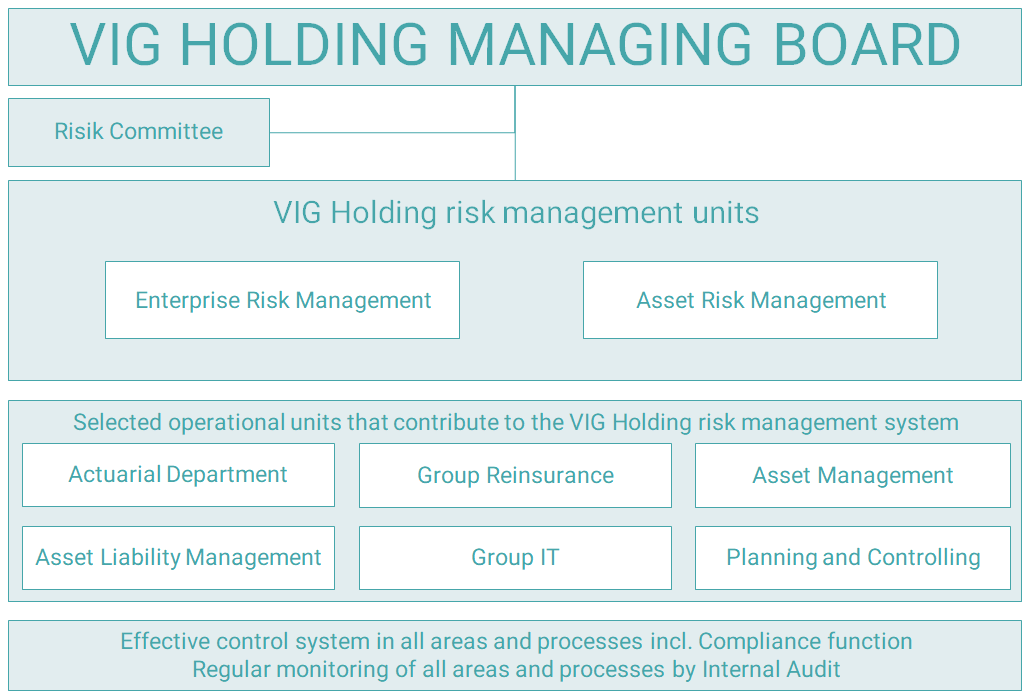
The Vienna Insurance Group is exposed to a number of other risks in addition to the underwriting risks of its insurance policy portfolio. A risk management process, supported by an effective risk organisation, is used to identify, analyse, evaluate, report, control and monitor these risks. The risk control measures used are avoidance, reduction, diversification, transfer and acceptance of risks and opportunities.

The graphic shows the areas involved in risk monitoring and control. On the top there is the managing board. Next to the managing board the risk controlling and risk committee are illustrated. Below the managing board the following areas are mentioned: Investment management, Internal actuarial department (Life/non-life actuarial practice), Ceded reinsurance and Controlling. On the one hand the risk types of each area (focus currently on financial/credit risks) and on the other hand the function of each area are listed. Investment management is responsible for market and credit risks and has to implement guidelines and practice active management. The Internal actuarial department is responsible for underwriting risks (direct) and has to implement guidelines and practice active management. Ceded reinsurance is responsible for insurance risks (non-life), particulary nat.cat./major risks, and has to implement guidelines and paractice active management. Controlling is responsible for strategic risks and operational risks and has to monitor compliance with guidelines.

24.01.2012 08:10

Preliminary development of Vienna Insurance Group in 2011*

Excellent corporate data despite a generally difficult economic situationPremiums written: growing...

more

more